Fundamentals of Computer > Introduction to Computer & Computer System > Classification of Computer
Classification According to Technology Being Used
Computer can be classified into three categories according to the working principle and the technology being used. These are:
- Analog Computer
- Digital Computer
- Hybrid Computer
Analog Computer:
This is a typed of computer that represents data by measurable physical quantities, such as temperature, pressure, acceleration, voltage, power, force etc. in order to solve a problem, rather than by expressing the data as numbers.
- In this computer, continuous varying electrical voltage is fed to as the input which are then manipulated using various electronic modules such as inverters, comparators, summers, multipliers, integrators etc. and the results are measured and displayed by meters, oscilloscopes etc.
- It uses continuous data for mathematical operations and utilizes mechanical or electrical energy.
- All operations in an analog computer are performed in parallel. Secondly, d
- Data are represented in an analog computer as voltages.
- A single capacitor in an analog computer can represent one entire continuous data.
Application:
- Analog computers are excellent for situations which require data to be measured directly without converting into numerals or codes.
- Analog computers have many applications in scientific and industrial fields in stimulating various physical systems or automatically controlling industrial process.


Figure: Mechanical Analog Computer
Digital Computer
A digital computer accepts discrete numbers as input and after performing the desired operations on these numbers, it produces discrete numbers as output. Digital circuits and are designed to operate on two states, namely bits 0 and 1, these are analogous to states ON and OFF. Data on these computers is represented as a series of 0s and 1s.
There are two types of digital computers: general purpose computers and special purpose computers. Special purpose computers are designed for specific types of data processing while general purpose computers are for general use. Early digital computers were electromechanical; electric switches drove mechanical relays to perform the calculation.
This type of computer typically includes some sort of device to store information, some method for input and output of data, and components that allow mathematical operations to be performed on stored data. Digital computers are the most widely used computers ever today.
Application:
- In the modern computer world of today, the uses of the digital computer are almost as limitless as a person's imagination.
- It can perform such tasks as to control industrial processes and regulate the operations of machines; analyze and organize vast amounts of business data; and simulate the behavior of dynamic systems in scientific research.
Hybrid Computer:
This type of computer combines the feature of both analog and digital computers. It has the speed of analog computer and the accuracy of digital computer. A hybrid computers operate by using digital to analogue convertor and analogue to digital convertor.
- In many cases, a hybrid computer is an analog computer controlled by a digital computer instead of human beings.
Application:
- Hybrid computers are widely used, for example, in an intensive care unit in which analog device measures a patient’s heart-function, temperature, pressure and other vital signs. These measurements are then converted into numbers and supplied to digital a component that monitors the patent’s vital signs.
- Hybrid computers are used at the space launch system when sending astronauts in the space for scientific research and exploration. This computer measures the temperature, wind, speed, humidity of the space and then translated these quantities into digital form for analysis and processing.
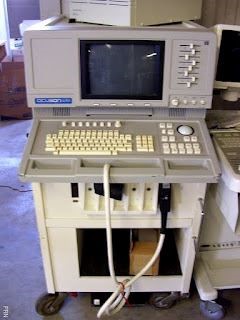
Differences between Analog and Digital Computer:
|
Factors |
Analog Computer |
Digital Computer |
|
Working principle |
Works on the principle of measurement |
Works on the principle of counting |
|
Data representation |
Can take any value over a continuous range to represent data |
Can take only discrete values to represent data |
|
Amplitude of signal |
Important factor |
Not so important |
|
Logical operation |
Cannot perform |
Can perform |
|
Design |
Not easy |
Easier |
|
Accuracy |
Provide less accurate results |
Provides 100% accurate results |
|
Output |
Produce output as voltage signals which are displayed by meters, oscilloscopes etc. |
Produce output as numbers which are displayed by monitor, printers etc. or stored in memory |
|
Reliability |
Less reliable |
Highly reliable |
|
Purpose |
Specific |
General |
|
Ease of use |
Difficult |
Easy |
Feedback
ABOUT
Statlearner
Statlearner STUDY
Statlearner