Business Analytics > Statistical Inference > Concept of Statistical Inference
What is Statistical Inference?
Statistical inference involves analyzing data collected from a random sample to draw conclusions, make predictions, or estimate characteristics of a broader population. It connects descriptive statistics with decision-making by accounting for uncertainty and variability, typically through techniques such as estimation and hypothesis testing.
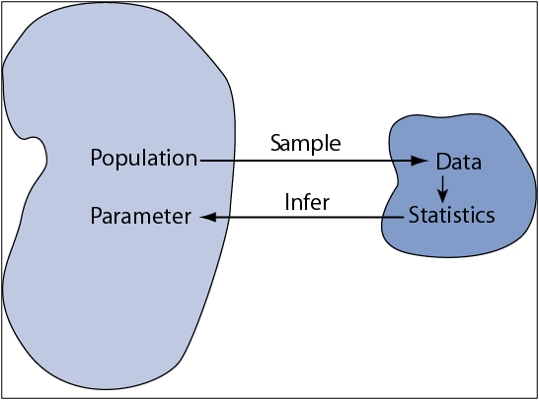
- Population: A statistical population is a group of items or individuals that we want to study. This group can be anything, as long as all members share at least one common characteristic.
- Sample: We use a small group of data to understand the whole group or population is called sample. Sample gives us measured values, which help us guess the true characteristics of the population.
- Parameter: A parameter in sampling is a numerical value that describes a characteristic of an entire population. For example: true average income of all people in a country. These values are usually unknown, because it is difficult to collect data from every member of the population. So, we use sample data to estimate them.
- Statistic: A statistic is a numerical value that describes a characteristic of a sample For example average marks of 50 students in a class. Statistics are calculated from sample data and are used to estimate population parameters.
- Estimation: We try to find close values for the population. For example, we use the average of a sample to guess the average of the whole population, or we give a range where the true value is likely to be.
- Hypothesis Testing: We check whether a claim about a population is likely to be true by using sample data. For example, we test if a new medicine really works.
- Prediction: We use existing data to make educated guesses about what might happen in the future.
No More
Next
What is an Hypothesis?
Feedback
ABOUT
Statlearner
Statlearner STUDY
Statlearner