Fundamentals of Computer > Introduction to Computer & Computer System > Evolution of Computer-02
- Slide Rule
This is a mechanical calculating device based on the principles of logarithms.
- It was invented by an English Mathematician named William Oughtred.
- This device was used to calculate multiplication, division, square root etc. using logarithm very quickly as that compared to Napier’s Bone.
- Before electronic calculators were developed, slide rules were the tool used most often in science and engineering.
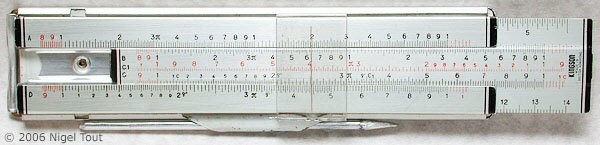
- A slide rule consists of three parts: body, slide and cursor.
- The body and the slide are marked with logarithmic scales.
- The scales (A-D) are labeled on the left-hand side of the slide rule. (Multiplication and division are performed using the C and D scales. Square and square root are performed with the A and B scales).
- The cursor has a hairline that facilitates accurate positioning of the cursor at a specific point on some scale.
Illustrating Slide Rule for multiplication:
Problem: Multiply 3 by 2 (3 x 2 = ?)
Solution:
- Move the sliding middle section with scale "C" so that the 1 on the scale matches the 3 on the lower fixed section with scale "D".
- Now read along the top scale to the 2 and see what it says on the bottom scale.
- The bottom scale should read approximately 6 which is the answer.
 |
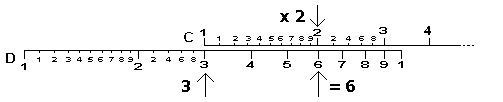 |
Figure-7: Calculating 3 x 2 on a Slide Rule
- Stepped Reckoner
Stepped Reckoner was a digital mechanical calculator invented by German mathematician Gottfried Leibniz in 1671.
- This is the first calculator which was able to perform multiplication, division, addition, subtraction, and square root.
Leibniz was the first man who started the usage of binary system.
Difference Engine:
The Difference Engine is an automatic mechanical calculator which was developed by the English mathematician Charles Babbage in 1820s.
- This device was used to perform simple mathematical computations needed for setting up trigonometric and logarithmic tables without any error.
Analytical Engine:
The Analytical Engine, developed in 1842 by Charles Babbage, was a prototype computer. This machine had a punched card input, a memory unit, an arithmetic unit and an automatic printout.
- It was to be capable of performing the basic arithmetic functions for any mathematical problem, and it was to do so at an average speed of 60 additions per minute.
Charles Babbage: The Father of Modern Computer
- Charles Babbage was a nineteenth century Professor of Mathematics at Cambridge University.
- He is considered the father of modern digital computers though his work did not directly influence the design of the first modern computer.
- His efforts established a number of principles, which have been shown to be fundamental to the design of any digital computer.
Babbage was unable to produce a working model of Analytical Engine
- because of financial difficulties as well as technological constraints (i.e. unavailable of the materials needed to manufacture the machine).
- Ada found out some errors on Babbage’s works and also wrote some programs for Babbage’s Analytical Engine.
Ada is the name of first programming language of the world which was developed by Augusta Ada Byron, the daughter of famous British poet Lord Byron. She is called the first programmer of the world.
After Babbage’s work on computers (1871), little progress was made until 1937. An important theoretical development occurred between 1847 and 1854. George Boole, an English Mathematician, developed an algebraic system called Boolean Algebra. Boolean Algebra is used widely today for representing and manipulating logical expressions and for the simplification of logic gates.
- Census Tabulator
Census Tabulator is a device developed by Herman Hollerith which was used to tally the results of the 1890 US census. This was the first wholly successful information processing system to replace pen and paper.
- Hand-counting results of 1880 census was proving impractical— it was laborious and error-prone operation that took a full 7 years to tabulate.
- Census Tabulator reduced a ten-year job to three months, saved the 1890 taxpayers five million dollars, and earned him an 1890 Columbia PhD.
Herman Hollerith at first introduced the concept of punched cards, which were extensively used as input medium in computers even in late 1970s.
Feedback
ABOUT
Statlearner
Statlearner STUDY
Statlearner