Big Data > Hadoop > Graph Database
Graph Databases
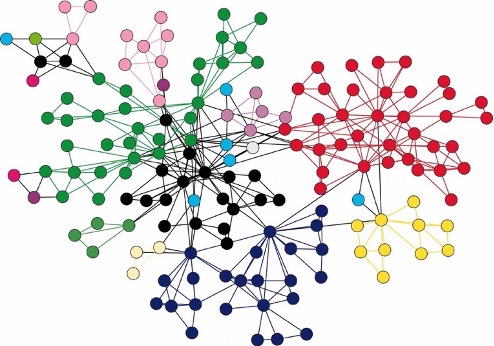
A graph database is a specialized database management system that stores and manages data as a network of nodes and edges, representing relationships between data points.
Nodes: Represent individual data entities or objects.
Edges: Represent the relationships or connections between nodes.
Properties: Attributes associated with nodes and edges, providing additional information about them.
Graph databases enable storage of entities and the relationships between them. In the graph database, entities are represented as nodes which have properties. Properties are represented as edges of the nodes with directionality being considered. Thus, graph databases enable us to not only store the data once but also allow us to interpret the same, in various ways, depending on the relationships indicated by edges. This feature is a unique strength of graph databases.
Popular Graph Database Examples:
Neo4j: A widely used and powerful graph database platform.
Amazon Neptune: A fully managed graph database service on AWS:.
ArangoDB: A multi-model database that supports graph data.
Dgraph: A distributed graph database known for its high performance.
JanusGraph: A distributed graph database optimized for scalability and performance.
TigerGraph: A proprietary graph database with features for data visualization and analysis.
Why Use a Graph Database
In complex Relationships, Graph databases are excellent for handling data with intricate and interconnected relationships, such as social networks, knowledge graphs, and recommendation systems.
- Show Connections Clearly: Think of a graph database like a map of a social network. It’s very easy to see how everything is connected without having to dig through lots of data.
- Find Relationships Fast: In a graph database, finding out how one piece of data is related to another is quick. It’s like being able to instantly see who your friends-of-friends are, without needing to search through every record one by one.
- Easy to Expand and Change: Graph databases are flexible. If we want to add new types of connections or new pieces of data, we can simply add more dots and lines without having to redo the entire system.
Some Real Applications
- Recommendation engines: People often search for similar products as others do. That is, if one person buys shoelaces after buying sneakers, there’s a good chance others will do the same. Recommendation engines look for people who are connected by their purchases and then look for other closely connected products in the graph.
- Fraud detection: Good customers rarely commit fraud, and fraudsters often follow the same pattern again and again. Building out a graph of transactions can identify fraud by flagging suspicious patterns that often have no connection to legitimate transactions.
- Knowledge networks: Some artificial intelligence researchers have been creating graphs of facts and the connections between them so that computers can approximate human reasoning by following paths.
- Routing: Finding a path in the world is much like finding a path in an abstract graph that’s modeling the roads. If the intersections are nodes, and the streets between them the links or edges, then the graph is a good abstract representation of the world. Choosing a path for an autonomous car just requires a sequence of nodes and links between them.
What are the different types of noSQL Databases
No More
Feedback
ABOUT
Statlearner
Statlearner STUDY
Statlearner