Information Theory and Coding > Data Compression > State Kraft Inequality with example
The basic objective is to construct instantaneous codes of minimum expected length to describe a given source. It is true that we cannot assign short codewords to all source symbols and still be prefix-free. The necessary and sufficient conditions for the existence of such a code are provided by the ‘Kraft Inequality’:
Given a source S = {s1, s2, …. sq}, X = {x1, x2 … xr}, let the word lengths of the codes corresponding to these symbols be l1, l2 …….lq. Then, an instantaneous code for the source exists that must satisfy the inequality:
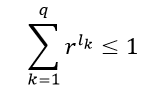
This inequality is called kraft inequality
Example: A six symbol source is encoded into Binary codes shown below.
Kraft Inequality test for Code A is:
X={0,1} hence R=2; L ={2,2,2,3,4,4}

Which satisfy kraft inequality. So code A is an instantaneous code
Feedback
ABOUT
Statlearner
Statlearner STUDY
Statlearner